New to multi-objective optimisation? Start with the Beginner’s Guide. From an industry or applied background? See Industry for application scenarios.
Research Overview
My research interests principally lie in AI, complex systems, and optimisation.
AI runs on trade-offs. Almost every interesting decision in modern AI is a balancing act between goals that pull against each other. Optimising a large language model means trading helpfulness against harmlessness, informativeness against conciseness, creativity against reliability. Building an agentic system means choosing which model fills which role, trading capability against latency and cost.
These are multi-objective optimisation problems. They rarely have a single best answer, but a set of best trade-offs — a Pareto front — and the real task is to find that set and let a decision-maker choose with the full picture in view, or switch the decision when circumstances change. As LLM and agentic systems take on more open-ended, higher-stakes tasks, the trade-off structure underneath them stops being a convenience to paper over and becomes something we have to understand directly.
That is the space my research works in — multi-objective combinatorial optimisation — problems with discrete, structured search spaces. This is the hard end of the field, and also the shape of many AI problems: assembling an agent team, selecting a feature set, configuring a system. The search spaces are rugged and deceptive, exact solutions are out of reach, and the algorithm we choose genuinely changes the outcome.
The honest state of practice is that people reach for a famous algorithm — NSGA-II, MOEA/D — and hope. My work pushes back on that by replacing guesswork with understanding: when a problem is hard, which algorithm should we trust, and why?
Algorithm Design
Designing multi-objective algorithms that keep making progress on rugged, deceptive, or highly constrained search spaces.
Analysing Algorithms
Understanding when evolutionary algorithms, local search, archives, and update rules work well for different problem classes.
Theoretical Studies
Runtime analysis and benchmark design that explain the fundamental behaviour of multi-objective optimisation algorithms.
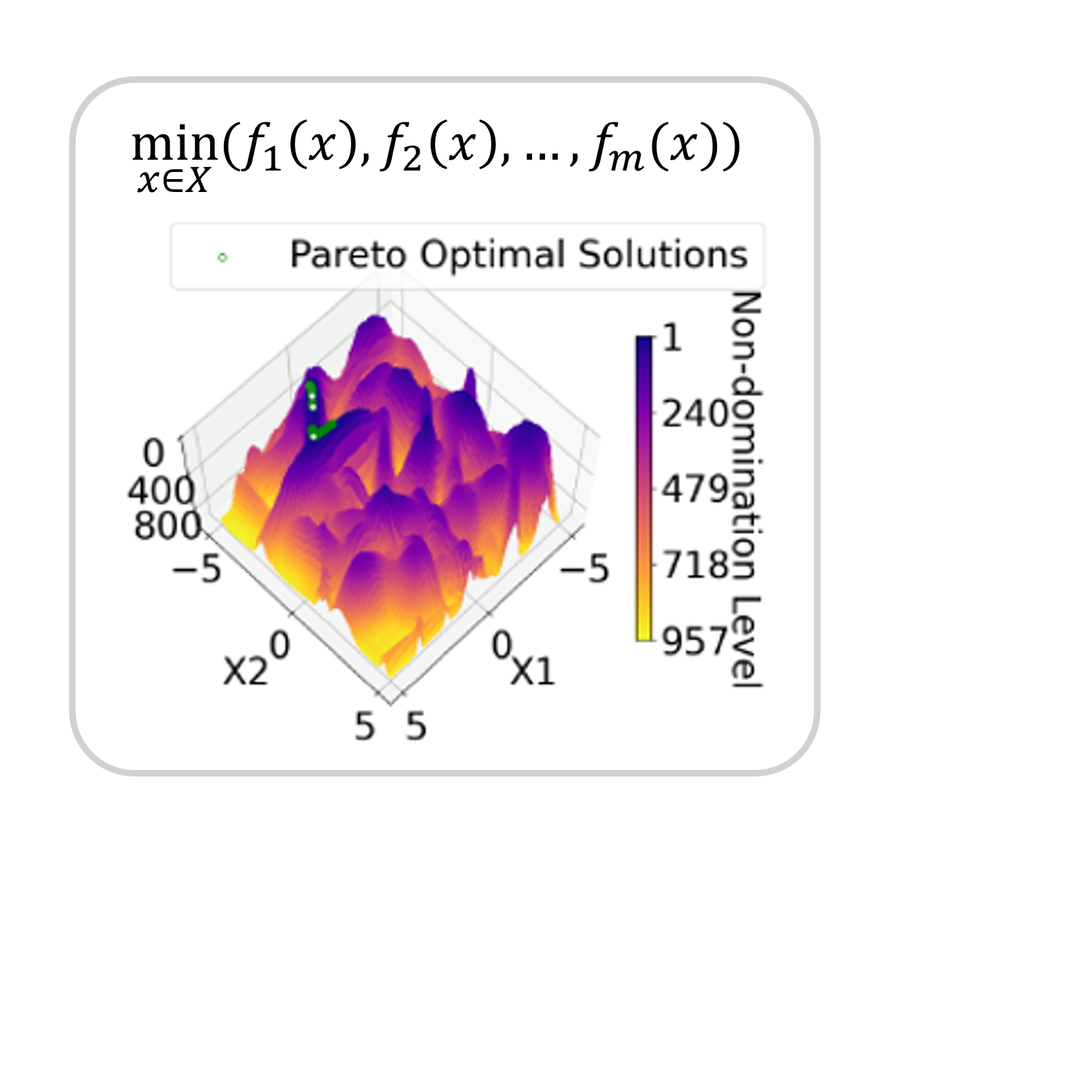
Landscape Visualisation
Visualisation methods for multi-objective fitness landscapes, designed to make problem structure easier to inspect and explain.
Other Research Interests
Early-stage interests include artificial life, multi-agent systems, science-technology-society questions, and procedural content generation.
How the pieces connect
Multi-objective optimisation is often presented through the Pareto front — the visible set of trade-off solutions. But the front is only the output of a deeper search process, and that process is what my work tries to understand: how an algorithm explores a landscape, when it should keep or discard a solution, how it uses memory, and what makes a problem easy or hard.
This is why the empirical and theoretical sides of my work feed each other. Empirical studies surface behaviours worth explaining. Theoretical analysis isolates the mechanism and proves when it holds. Benchmark design makes those formal settings more realistic. Visualisation makes problem structure concrete enough to inspect, teach, and debug. Together they turn algorithm choice from a black-box race into a diagnosis.
Why this matters now
These findings were established on classic combinatorial problems — travelling salesman, knapsack, assignment, NK-landscapes. But the findings themselves are about search: how exploration and memory should be balanced when a problem is rugged, deceptive, and multi-objective. That description fits a growing share of AI engineering.
The connection is becoming concrete. Neural combinatorial optimisation — learning a model to solve combinatorial problems directly — is now a serious alternative to evolutionary search, and the same questions apply to it: what does its search landscape look like, where does it get stuck, and when does a learned solver actually beat a classical one? Understanding search behaviour is not a niche concern of evolutionary computation. It is the groundwork for reasoning rigorously about the multi-objective systems — classical, learned, and agentic — that the AI field is now building.
For the published record, see the Publication page.
What we are learning about search
A recurring theme across these projects is that the field’s reflexes — the things everyone does by default — are often wrong on hard combinatorial problems. Three reflexes, three corrections.
Reflex: elaborate algorithms beat simple ones? A very simple algorithm with no crossover, no diversity mechanism, and no clever selection can match or beat NSGA-II and other well-established MOEAs on a range of combinatorial problems. The reason is not magic: a sophisticated component added for one kind of landscape can quietly sabotage the search on another. Crossover, in particular, speeds search up on smooth landscapes but actively hurts on rugged ones. The useful conclusion is not “simple is always better” — it is that a mechanism we understand beats a mechanism we merely assume.
That lesson cuts both ways. Pushed to large problems — thousands of variables — the same simple algorithm begins to lose: its convergence slows markedly next to algorithms that use crossover. Simplicity is not a free lunch; it is a trade-off whose terms depend on problem size and structure. Knowing where the trade-off turns is the actual contribution.
Reflex: always keep your best solutions? Almost every modern MOEA is elitist — it protects the best solutions found so far. That instinct is sound early in a search, but once the search stalls in a local optimum, those same best solutions stop producing progress. Solutions usually dismissed as inferior — dominated solutions — can act as bridges out of the trap. Letting go of strict elitism, or deliberately storing and reusing dominated solutions, makes a search markedly better on hard, deceptive problems.
Reflex: one population does everything? A single population is usually asked to do two conflicting jobs at once: exploit the good solutions it has, and explore toward new regions. The best solutions for exploitation are often the worst for exploration, and vice versa. Splitting these jobs across two populations — one guarding quality, one kept deliberately diverse — can deliver large, provable speed-ups over forcing one population to compromise.
A related thread is how a search moves locally. Scanning a neighbourhood systematically feels efficient — you never revisit an option. Yet sampling neighbours at random, with all its apparent redundancy, finds good solutions faster, because of how useful moves are distributed during a search.
Future Directions
I am extending this work along two lines. The first is multi-objective neural combinatorial optimisation — bringing the search-behaviour and fitness-landscape lens to learned solvers, and asking how they compare with evolutionary algorithms. The second is multi-agent systems and the multi-objective trade-offs inside LLM-based agent teams.
I also have broader interests in artificial life, the intersection of science, technology, society, and environment (STSE), and multi-objective procedural content generation. These share the same core interest: understanding complex systems that must act under multiple, interacting criteria.