
Multi-Objective Optimisation
What is multi-objective optimisation?
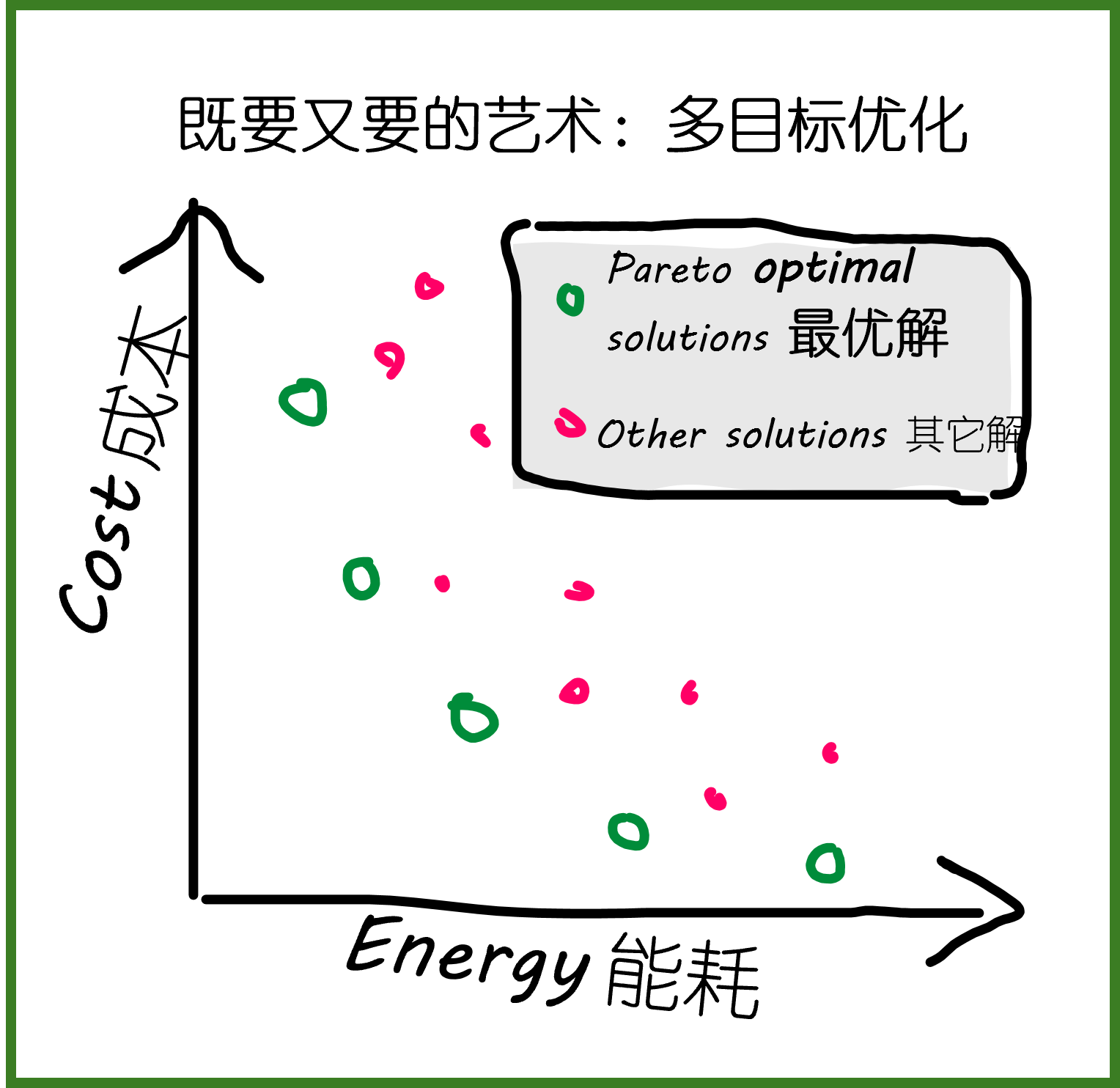
Imagine buying a fridge. You want to spend less money (cost) and also want it to use less energy. These goals often conflict: an inexpensive older fridge may consume more power, while a more efficient new one may cost more.
Multi-objective optimisation is the process of balancing several conflicting goals at the same time.
Why does it matter?
Real life is full of these trade-offs:
- Engineering design: a car should be affordable, safe, and energy-efficient. Entry-level, mid-range, and premium models each represent a different balance.
- Time management: work, family, rest, and personal interests all compete for limited time.
- Shopping decisions: with a limited budget, some products look better while others perform better; a useful choice must balance both.
Why is it difficult?
There is no single perfect answer
Trade-offs are unavoidable. Instead of finding one universal winner, we usually seek a diverse set of strong alternatives, such as the green solutions in the illustration: some are cheaper and others use less energy.
Poor solutions vastly outnumber good ones
Many choices, like the pink points, perform badly on both objectives and should be eliminated. Finding even one optimum can be hard; finding a representative set of them is harder.
Strategy and configuration matter
Well-known algorithms such as NSGA-II and MOEA/D are common first choices, but they are not automatically the best fit. Even when an algorithm is suitable, its configuration can substantially change performance.
Decision-making comes next
After an algorithm finds a set of trade-off solutions, a decision-maker still has to select the most suitable one—or a small range of low-, middle-, and high-end options—according to current priorities.
In short, multi-objective optimisation is the art of achieving “both-and” in a world of trade-offs.